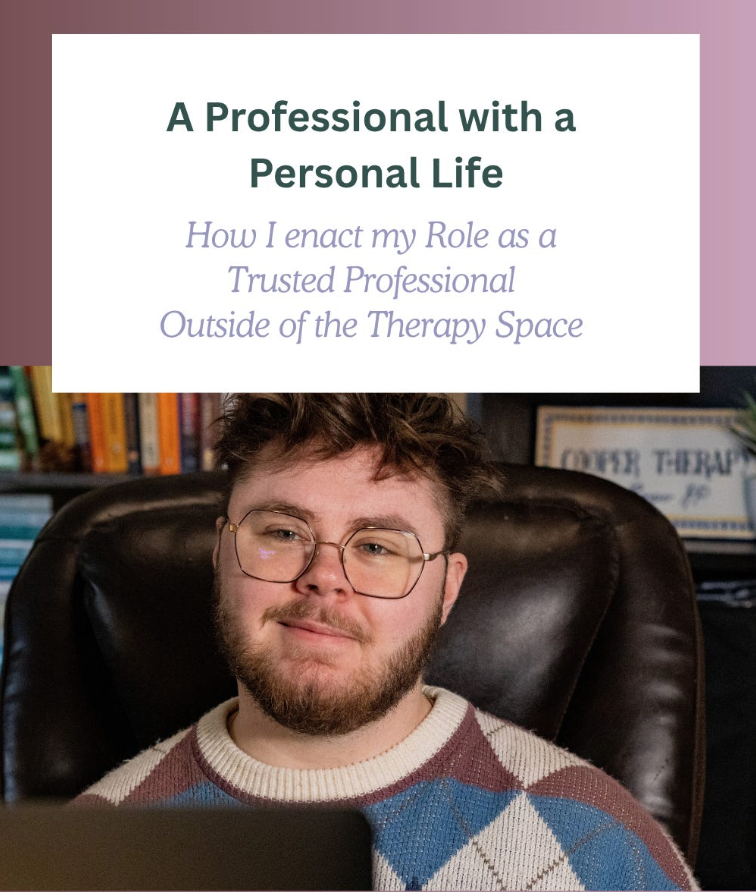
A PROFESSIONAL WITH A PERSONAL LIFE
Client: Cooper Therapy
Role: editorial development, structural editing, and ghostwriting support
Last week, I wrote about how therapy is political, what is required to uphold the CRPO Code of Ethics, and what it means to be a trusted professional.
In Ontario, the concept of a “trusted professional” is not defined by a single statute, but rather through a framework of regulated professions and codes of ethics mandated by regulatory colleges or employers. Being a “trusted professional” doesn’t turn off when I close my office door. I believe this wholeheartedly. But I also know that it can be hard (and yes, uncomfortable) to start to concretize this in our daily, jumbled-up lives.
So this is less a set of instructions and more a personal checklist. These are the things I try to hold myself to consistently enough to whittle away at the gap between what I say in session and how I move through the world.
1. I strive for congruence, not perfection.
We’re all human. You don’t need to be flawless, and I don’t need to be flawless. That would be an absurd goal.
But I do try to notice when my values start to shift depending on what room I’m in. And when I notice it, I put a stop to it. If I advocate for dignity and anti-oppression in session, that should still be present at dinner parties and in the group chat.
2. I interrupt harm clearly.
It is almost always extremely uncomfortable. I practice (beforehand) responding to discriminatory jokes or misinformation arising in social settings, and then I try my best to follow through in real-life. Again, I’m not perfect.
Remember that silence communicates and embodies its own form of participation.
3. I think carefully about how I show up online.
My digital presence isn’t separate from my professional one; I don’t really think anyone’s is.
Before engaging, liking, sharing, or posting, I think about what that action will signal about who I am and what I believe. Does it hold up to my professional ethical standards? Would I feel comfortable standing behind this in front of a client? My regulator? A colleague? Myself, 5 years from now?
CONTINUE READING